You play using tabs and manage quite well, but feel deep down that there’s more to it? Put an end to the guesswork! In this guide, we’ll decode the secrets of music notation for you. We’ll show you exactly how to read guitar sheet music and discover a musical world that goes far beyond tabs. Learn to truly understand music, capture rhythms precisely, and communicate with other musicians on a level playing field. Are you ready to unleash your true potential on the guitar?
The Essentials of Reading Guitar Music at a Glance
Basically: Learning how to read guitar sheet music expands your musical understanding and makes you more independent of tabs.
Important: Start in the first position and learn the open strings and their notes first.
Tip: Practise daily in small units, combine reading music with simple songs, and build up your confidence step by step.
Why You Should Learn to Read Music as a Guitarist
Especially in the world of electric guitar and around the campfire, you often hear the phrase: "Tabs are plenty!" And yes, for many rock riffs and solos, tablature is a fantastic tool. But if you want to learn guitar - and do it properly - knowing how to read guitar sheet music is a real game-changer.
Imagine being able to pick up an unknown piece and immediately hear how the melody sounds without anyone playing it for you first. Those who can read music understand musical context, harmonies, and rhythms much more deeply. You transform from simply copying others into becoming a real musician
Learn guitar with music2me!
Do you dream of playing your favourite songs around the campfire or rocking out to the riffs of your heroes? With music2me, you can learn guitar at your own pace – step by step with a system that truly helps you progress, whether you’re a beginner or already advanced.
Over 400 video lessons & downloadable sheet music
Interactive tools like Skill Check & smart practice mode
Weekly live classes & personal teacher support
Exclusive Discord community for motivation & exchange
Show you where to place your fingers (e.g. "String 2, Fret 3"). They are great for a quick start but often tell you little about the exact rhythm or note duration.
Sheet Music
Shows you which note sounds and how long it lasts. Reading music makes you more independent, creative, and musical.
Our Recommendation: Use tabs for quick riffs, but learn sheet music to play rhythms precisely, master classical pieces, and truly grasp music theory. You can find out more about how to read tabs properly here.
The Basics: How a Sheet of Music is Structured
Before we pick up the guitar, let’s look at the map: the staff (or stave). Don’t worry, grasping the basics of how to read guitar sheet music is easier than it looks. You can find a detailed overview of the world of reading music in our comprehensive guide.
The staff: It consists of five lines and four spaces.
The Position: The higher a note is placed, the higher the pitch.
Ledger Lines: Notes that are too high or too low for the five lines get their own little "ladders" (ledger lines).
The Treble Clef: For guitarists, this (also called the G-clef) is crucial. It circles the second line from the bottom, marking the note G.
Time Signature: Usually placed directly after the clef (e.g. 4/4), revealing the song's basic rhythmic pulse.
Bar Lines: These vertical lines divide the staff into small, manageable sections called bars.
Pro Tip: Sometimes you’ll see a small "8" under the treble clef. This simply means the guitar sounds one octave lower than written. You don’t need to worry about this when starting out.
The Two Pillars of Music: Pitch and Rhythm
To understand how to read guitar sheet music, you need to grasp two things: which note to play (pitch) and how long to hold it (rhythm).
1. Which Note Do I Play? (Pitch)
The note names you should memorise first are the natural notes: C, D, E, F, G, A, B. (Note: In German notation, B is often called H, but internationally and in the UK, it is B). These notes are distributed across the lines and spaces.
Additionally, there are accidentals that change a note:
A Sharp (♯) raises a note by a semitone (e.g., F becomes F sharp / F#).
A Flat (♭) lowers a note by a semitone (e.g., B becomes B flat / Bb).
Natural Notes
C, D, E, F, G, A, B
Sharps
C♯, D♯, E♯, F♯, G♯, A♯, B♯
Flats
C♭, D♭, E♭, F♭, G♭, A♭, B♭
2. How long do I play a note? (Rhythm)
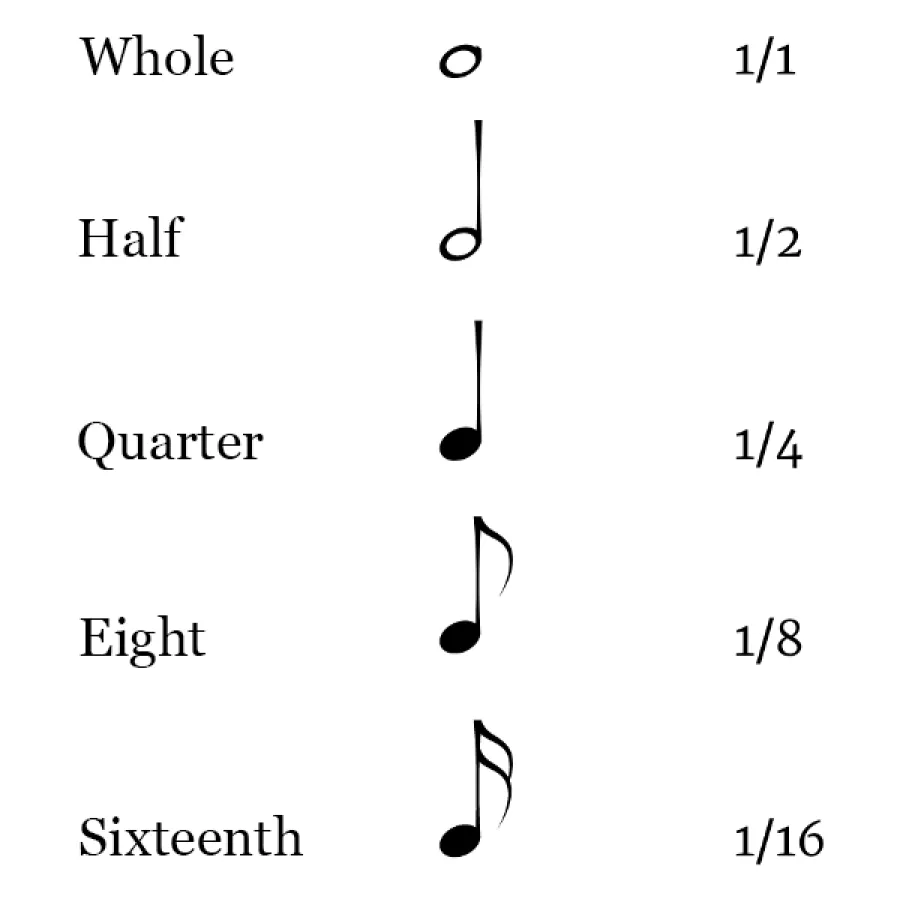
The rhythm is determined by the appearance of the note. These are called note values. Here are the most important ones for beginners:
Whole Note: Lasts 4 beats (looks like an empty oval).
Half Note: Lasts 2 beats (has a stem but the head is not filled in).
Quarter Note: Lasts 1 beat (filled in and has a stem).
Eighth Note: Lasts half a beat (has a flag added to the stem).
Sixteenth Note: Lasts a quarter of a beat (has two flags).
Tip: To play the rhythm correctly, a metronome is your best friend. It gives you a constant pulse to orient yourself by.
The Notes on the Guitar
Every fret on the guitar raises the tone by one semitone. You can learn all the notes on the guitar up to the 12th fret. Don't panic: very often, the notes have two names (e.g. G# is the same as Ab).
The sequence of these notes corresponds to the chromatic scale:
C - C#/Db - D - D#/Eb - E - F - F#/Gb - G - G#/Ab - A - A#/Bb - B
Now for the guitar’s special feature: Many notes can be played in different places. Example: You can play the note C on the B-string at the 1st fret, on the G-string at the 5th fret, or on the D-string at the 10th fret – they all sound at the same pitch. This is confusing at first but has advantages: You can play in different positions and adjust your fingering.
Step by Step: Learning Notes on the Guitar
Step 1: The Notes of the Open Strings
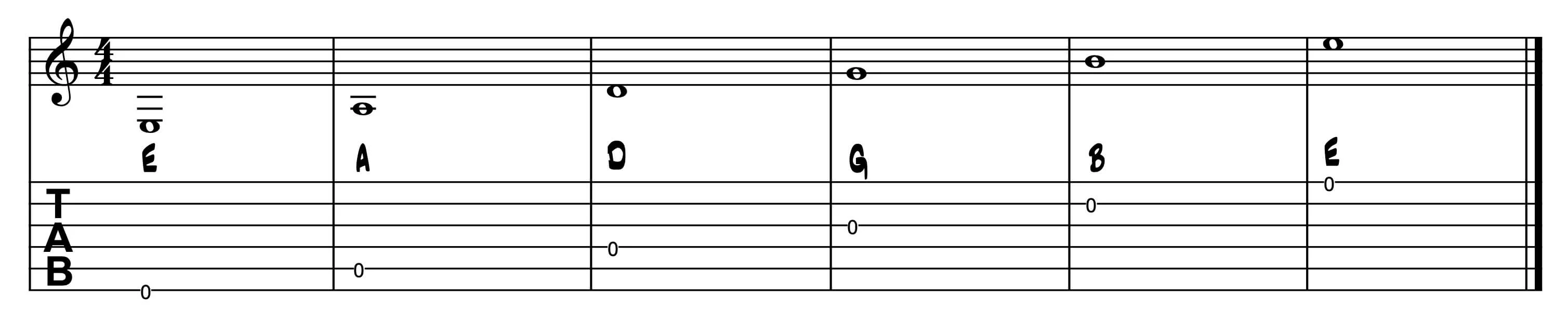
Your foundation is the six open strings. Memorise them, both their names and their position on the staff:
E – Low E-string: Below the third ledger line (very low).
A – A-string: On the second ledger line below the staff.
D – D-string: Directly below the bottom staff line.
G – G-string: On the second line from the bottom.
B – B-string: On the middle line.
E – High E-string: In the top space.
A popular mnemonic for the strings (E-A-D-G-B-e) is: EddieAteDynamiteGoodByeEddie.
Step 2: The First Position as a Starting Point
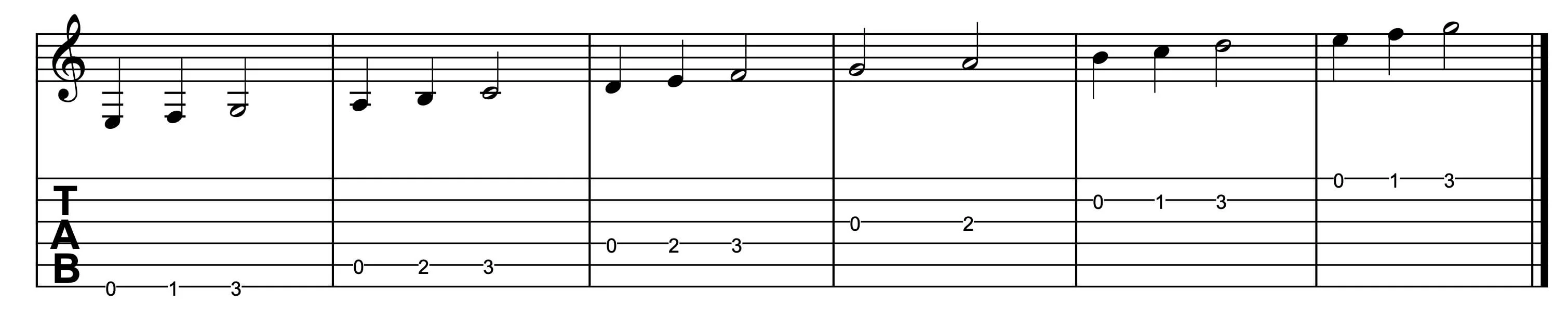
At the beginning, focus exclusively on the first position. This means you only use the open strings and frets 1 to 4. Your index finger handles the 1st fret, the middle finger the 2nd, and so on. If you practise this on all strings, you’ll have a solid foundation.
An example on the high E-string:
Open string: Note E
1st Fret: Note F
3rd Fret: Note G
Tip: Don’t learn all strings at once. Take one string per week and play small melodies using only those notes. This helps your brain automatically link the sheet music visual, the pitch, and the grip.
Step 3: Connect Pitch and Rhythm with Simple Songs
Once you know a few notes, look for dead-simple melodies like nursery rhymes ("Twinkle, Twinkle, Little Star" or "Frère Jacques"). These songs usually use only a few notes and simple rhythms (quarter and half notes). The process is always the same:
Clap the Rhythm: Look only at the rhythm and clap it while counting the beats (1, 2, 3, 4) out loud.
Speak the Notes: Go through the melody note by note and speak the names out loud without playing.
Put it Together: Now play the melody slowly on the guitar.
The Best Tips for Your Learning Success
Practise in Mini-Units: It is better to do 10 minutes intensively every day than two hours once a week. Your brain needs regular repetition.
Use Modern Tools: A metronome is mandatory for timing. Interactive players are even better. In the music2me guitar course, you see exactly what the teacher is playing in the video, while a cursor moves synchronously through the sheet music below. This automatically links image, sound, and notation.
Flashcards & Note Bingo: Write notes on index cards, draw one, and find it as quickly as possible on the fretboard.
Be Patient: If you get stuck, take a step back to the open strings. That is completely normal!
Why Digital Learning Makes a Difference with Sheet Music
Of course, you can learn notes from books. But digital tools offer decisive advantages that not only speed up your learning process but also make it much more flexible:
Set Your Own Pace: You aren’t tied to rigid appointments. You decide how fast you progress and can repeat lessons as often as you like until you feel confident.
Theory Meets Practice: Dry theory is often abstract and boring. At music2me, you learn a theoretical concept and immediately apply it in a real song. This mix of music theory and practice helps you internalise what you’ve learned straight away and keeps the fun in playing.
Additional Material: Want to practise offline on your guitar sometimes? No problem. Professional sheet music and fingerings are available to print out for the lessons, keeping you flexible at all times.
Your Path to Becoming a Confident Guitarist
Learning to read music for guitar isn’t wizardry. It’s a mixture of patience, repetition, and small victories. Remember: every note you learn expands your musical vocabulary and makes you a more flexible, creative guitarist.
So: Guitar in hand, sheet music on the stand and off you go!
Frequently Asked Questions About Reading Guitar Sheet Music
Is reading music harder for guitar than for other instruments?
Yes, a little bit - many notes can be played on multiple strings. However, with a systematic approach, it is very manageable. We are happy to help you with that.
Do I have to memorise all the notes on the fretboard immediately?
No, absolutely not! Start with the open strings and the first position (the first three to four frets). That already covers hundreds of songs. Only when that sticks do you work your way forward, fret by fret.
Should I learn rhythm or pitch first?
Both are important. Many start with rhythms because you can clap or speak them before playing them on the guitar.
How long does it take until I can read music fluently?
That depends on how much you practise. With 10 minutes a day, you can read simple pieces confidently within a few months.
Do I need to read music if I only want to play Rock or Pop?
Not necessarily - tabs are often enough for that. But reading music makes you more flexible, e.g. if you want to improvise, understand music theory, or play together with others.
Want to learn guitar but don't know where to start? This guide walks you through the first essential steps — perfect for beginners who want to make quick progress.
You'll receive valuable insights on choosing the right guitar, proper playing and posture techniques, and how to read music and tablature. You'll also learn how to play chords, take care of your guitar, and discover the secrets of effective practice to continuously improve your playing. Let's get started!
You want to learn to play the guitar but are unsure which type of lessons suits you – and what the whole thing might cost? In this article, you'll find a comprehensive overview of the various forms of guitar lessons: from music schools and private lessons to online courses. We’ll show you what prices to expect, what factors influence the cost, and how you can learn guitar even on a tight budget.
You want to learn electric guitar and don't know exactly where to start? Don't worry – the beginning is easier than you think. In this guide, we'll show you how to master your first songs with the right equipment, a structured learning plan, and lots of fun in 5 clear and simple steps.
Whether you love rock, pop, metal, or blues, the electric guitar offers you all kinds of sound possibilities. Let’s get started!