Do you want to play solos that give people goosebumps? Then guitar bending is your absolute superpower! It’s the technique that can make an electric guitar weep, scream, and sing. From the emotional blues of B.B. King to the epic rock anthems of Slash or David Gilmour – string bending is at the heart of every expressive guitar solo.
We won’t just show you the dry technique here, but also how you can achieve the sound of your rock idols with the right bending and give your guitar a true voice. Buckle up, it’s going to get emotional!
Fundamentally: Guitar bending (or string bending) is a playing technique where you pull or push a plucked string with your fretting hand to smoothly raise its pitch.
Important: Intonation is the be-all and end-all! You have to hit the target note exactly so that the bend sounds clean and not out of tune. Always use multiple fingers to have enough strength and control.
Tip: To train your ear, play the target note normally first (e.g., on the 7th fret) and then try to hit this note exactly by bending (e.g., starting from the 5th fret).
Guitar Bending Explained Step-by-Step in our Video
Not a fan of endlessly long texts? No problem – in the following video we explain what guitar bending is all about:
to view this content.
What Is Bending and Why Is It Essential for Rock Solos?
Imagine you’re playing a solo: The notes are correct, the rhythm is spot on, but something is missing. It sounds sterile, almost like a computer. Bending is what adds the human, emotional, and often raw element to your playing. It’s basically the guitar version of the human voice.
By bending the string, you create a fluid change in pitch that provides enormous expressiveness. In rock, guitar bending is essential for building tension, making melodies sing, and creating that legendary, larger-than-life sound we all love. If you want to master the basics of playing solos, this is a crucial step on your journey to becoming a rock star.
Learn guitar with music2me!
Do you dream of playing your favourite songs around the campfire or rocking out to the riffs of your heroes? With music2me, you can learn guitar at your own pace – step by step with a system that truly helps you progress, whether you’re a beginner or already advanced.
Over 400 video lessons & downloadable sheet music
Interactive tools like Skill Check & smart practice mode
Weekly live classes & personal teacher support
Exclusive Discord community for motivation & exchange
The Right Technique: How to Bend Strings Like a Pro
A powerful and clean bend doesn’t just come from your fingertips, but from a coordinated movement of your entire wrist. Here is how you do it step by step:
Stable Hand Position: Place your thumb over the edge of the guitar neck. This gives you the necessary leverage and stability. Your fingers should be slightly angled on the fretboard.
Use Multiple Fingers: Even if you’re only fretting one note (e.g., with your ring finger), let your other fingers (middle and index fingers) help out behind it on the same string for support. This gives you significantly more strength and control.
Mute the Other Strings: Lay your index finger flat across the strings you aren’t playing. This prevents unwanted background noise, ensuring your bend sounds clean and defined.
The Movement Comes From the Wrist: Pluck the string and then bend it. The power comes from a twisting motion of your wrist, as if you were turning a doorknob. Your fingers remain curved and stable.
Up or Down? Whether you push the string up (towards the ceiling) or pull it down (towards the floor) is a matter of preference and depends on the string. On the high strings (G, B, E), you usually push upwards, whereas on the low strings (E, A, D), you tend to pull downwards. The effect is the same: the pitch gets higher.
What Types of Bends Are There?
Bending is an incredibly versatile technique that gives your guitar playing a massive dose of expressiveness. It’s not just about yanking a string somehow, but about shaping notes deliberately. The foundation lies in semitones and whole tones.
Semitone Bend
Whole Tone Bend
You bend a note so high that it sounds like the note one fret higher.
You bend a note so high that it sounds like the note two frets higher.
Based on this, various bending styles have developed, each creating a unique sound of its own. Let’s take a look at the most important ones together!
1. The Classic Bend
This is the most fundamental form of string bending and the one you’ll use most often. You pluck a note and immediately push (or pull) the string to raise the pitch precisely – usually by a semitone or a whole tone.
2. Bend & Release: The Yo-Yo Effect
Here, you bring the note back to its starting point. You pluck a note, bend it to the desired pitch, and then let the string glide back to its original position slowly and in a controlled manner while the note is still ringing. This creates a "weeping" or "singing" effect that can sound incredibly emotional.
3. Pre-Bend: The Surprise Effect
This technique is the exact opposite of the classic bend and requires a bit of practice. You first bend the string to the target pitch (e.g., a whole tone up) without plucking it. Only when the string is already under tension do you pick the note. Often, you then let the bent note fall straight back to its starting position (a pre-bend and release). This is perfect for dramatic and surprising moments in a solo.
4. Smear Bend: The Secret of the Blue Notes
This is all about feeling, not perfection. As the name suggests, you "smear" the note. You bend the string only minimally, usually by a quarter tone – which is less than a semitone step. This slightly "off" pitch is the heart of the blues and is often used to create the famous blue notes that provide that typically melancholic blues sound.
5. Unison Bend: Two Strings, One Note
A brilliant trick that instantly makes your playing sound fuller and more professional. You play two adjacent strings simultaneously, bending the lower note until it is the exact same pitch as the higher, unbent note. The result is a floating, almost chorus-like sound.
Example to try out: Fret the 5th fret of the B string with your index finger (this is the note E). At the same time, fret the 7th fret of the G string (the note D) with your ring finger and support it with your middle finger. Now pluck both strings (G and B) at the same time and bend the G string up a whole tone with your ring finger. If you do everything right, you’ll hear the same pitch on both strings – a clear, pure E.
The Bending of Rock Legends: Find Your Style
Every great rock guitarist has their own unmistakable bending style. By listening to them, you can learn an incredible amount and find your own expression.
Angus Young (AC/DC): Pure rock 'n' roll energy! Angus Young’s bends are often short, sharp, and straight to the point. He combines them with his signature wild vibrato, which makes his sound so distinctive. Audio Example: The solo from "Highway to Hell":
David Gilmour (Pink Floyd): The master of slow, epic bends. His bends are often very high (sometimes 1.5 or 2 whole tones) and perfectly intonated. He lets the notes ring out for a long time and adds a slow, controlled vibrato that gives you goosebumps. Audio Example: The solo from "Another Brick in the Wall, Pt. 2".
Slash (Guns N' Roses): His style is blues-drenched, aggressive, and full of passion. He uses a lot of quick semitone bends (so-called "curl bends") and often combines them with fast licks. His bending vibrato is rapid and intense. Audio Example: The intro solo from "Sweet Child O' Mine".
Learn Over 70 Rock Songs and Riffs with music2me!
Do you dream of playing the songs of your heroes? Our "Rock Songs & Riffs" module is your ticket into the world of rock guitar. From immortal rock anthems to grunge and modern riffs – we show you in easy-to-understand video lessons how to truly rock out using techniques like guitar bending and slides!
Your First Rock Lick With Bending (Incl. Tablature)
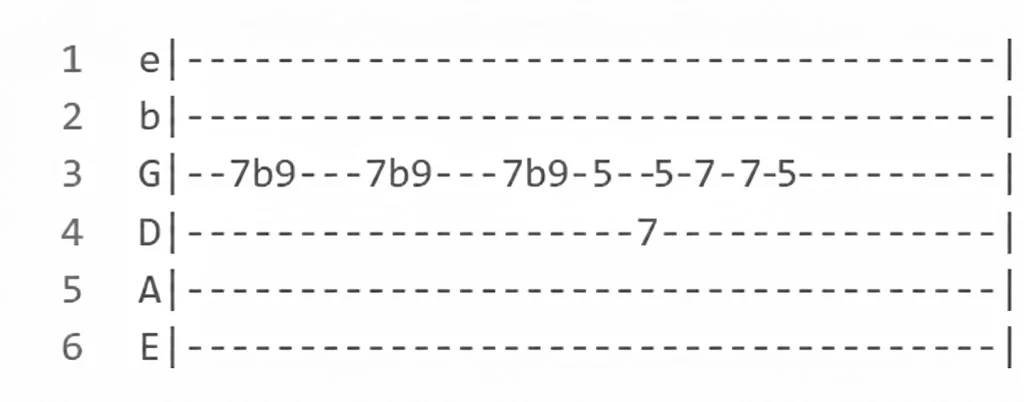
Enough theory, let’s rock! We’ve prepared a simple but absolutely classic-sounding lick for you. It comes from the A minor pentatonic scale, the most important scale for rock and blues solos. With this little melody, you’re taking your first big step from a simple chord strummer to a real lead guitarist.
Grab your guitar and try this out:
The Bend (7b9): This is the most important part. You fret the G string at the 7th fret and pluck it. Immediately afterwards, you push the string up until it sounds as if you were playing the 9th fret. This is called a whole tone bend (two frets). Hold the note briefly.
Repetition: Do exactly the same thing again. This helps you get a feel for the right pitch.
The Resolution (5-7-5): After the bends, you play the notes on the same G string one after the other at the 5th fret, then the 7th fret, and back to the 5th fret.
The Final Note (7): To finish, casually play the note on the D string at the 7th fret. This is the root note "A", which gives the lick a cool, resolved ending.
Pro Tip: Play the lick extremely slowly at first. Focus on making your bends sound genuinely clean and perfectly pitched. It’s better to play it slowly and correctly once than ten times fast and out of tune.
Exercise to Perfect Your Guitar Bending
Bending requires precision. The following exercise will help you hit the target note correctly and thus perfect your bending.
Play the starting note of the desired bend.
Play the target note of the bend.
Now, play the corresponding bend to match.
Switch back and forth between the two – the two neatly played notes and the corresponding bend – until your bend sounds perfect.
6 Tips to Make String Bending Easier and Better
Hear the target note: Before you bend, play the note you want to hit. This helps your ear memorize the correct pitch.
Less is more: A single, perfectly placed, and soulful bend is more effective than ten sloppy ones.
Thinner strings help: Especially in the beginning, string bending is exhausting. Thinner strings (e.g., a .009 set) have less tension and are easier to bend.
From bend to vibrato: Don’t just let a bend "die". Hold the note at its highest point and add a lovely vibrato to keep it alive.
Practise with a tuner: To check your intonation, you can practise in front of a tuner. This lets you see exactly whether you’re hitting the target note perfectly.
Be Patient: No one becomes a bending god overnight. It’s a skill that requires finger strength and a good ear. Practise regularly, and you’ll make quick progress.
Bending Is More Than Just a Technique – It’s Feeling
You now have the tools to take your guitar solos to a completely new level with guitar bending. Always remember: it’s not just about yanking the string upwards somehow. It’s about expression, about feeling, about telling a story. Listen closely to your favourite guitarists and try to mimic their expression. Experiment, be bold, and find your own bending style. Because at the end of the day, bending is the technique that brings out your personality as a guitarist the most clearly. So, what are you waiting for? Let your guitar sing!
Frequently Asked Questions About Guitar Bending
Why does my bend sound out of tune?
The most common issue is intonation. You are either not pushing the string far enough or pushing it too far. Practise specifically by playing the target note beforehand and then hitting it exactly with the bend. A tuner can help with this.
Which strings are best for bending?
Thinner strings (e.g., gauges .009-.042 or .010-.046) are easier to bend because they have less tension. Thicker strings require more strength but often deliver a fatter tone.
Can you also play bends on an acoustic guitar?
Yes, but it is significantly harder. The strings have higher tension, and you can usually only bend them a semitone or, with a lot of strength, a whole tone. On the electric guitar, it is the flagship technique.
How do I add vibrato to a bend?
Hold the string at the highest position of the bend and move your hand slightly up and down quickly but with control. This creates the floating pitch variation of a vibrato.
What are the most common beginner mistakes when bending?
The most common mistakes are sloppy intonation, a lack of strength (using only one finger), and failing to mute the other strings, which leads to background noise.
Want to learn guitar but don't know where to start? This guide walks you through the first essential steps — perfect for beginners who want to make quick progress.
You'll receive valuable insights on choosing the right guitar, proper playing and posture techniques, and how to read music and tablature. You'll also learn how to play chords, take care of your guitar, and discover the secrets of effective practice to continuously improve your playing. Let's get started!
You want to learn to play the guitar but are unsure which type of lessons suits you – and what the whole thing might cost? In this article, you'll find a comprehensive overview of the various forms of guitar lessons: from music schools and private lessons to online courses. We’ll show you what prices to expect, what factors influence the cost, and how you can learn guitar even on a tight budget.
You want to learn electric guitar and don't know exactly where to start? Don't worry – the beginning is easier than you think. In this guide, we'll show you how to master your first songs with the right equipment, a structured learning plan, and lots of fun in 5 clear and simple steps.
Whether you love rock, pop, metal, or blues, the electric guitar offers you all kinds of sound possibilities. Let’s get started!